Project Overview
Coastal communities face growing risks from hazards, worsened by the effects of climate change and sea-level rise (SLR). The US East Coast is particularly vulnerable, with nearly twice the global rates of SLR. Neglecting these greater issues in climate change adaptation efforts can worsen inequalities and further harm vulnerable communities. The Risks, Impacts, & Strategies for Coastal Communities (RISCC) project brings together researchers and community stakeholders from three of the lowest-lying states in the country–Delaware, Rhode Island, and South Carolina. This project’s goal is to advance interdisciplinary research that empowers communities deeply affected by climate hazards and salinization, informing effective adaptation decisions that support long-term resilience in coastal towns.
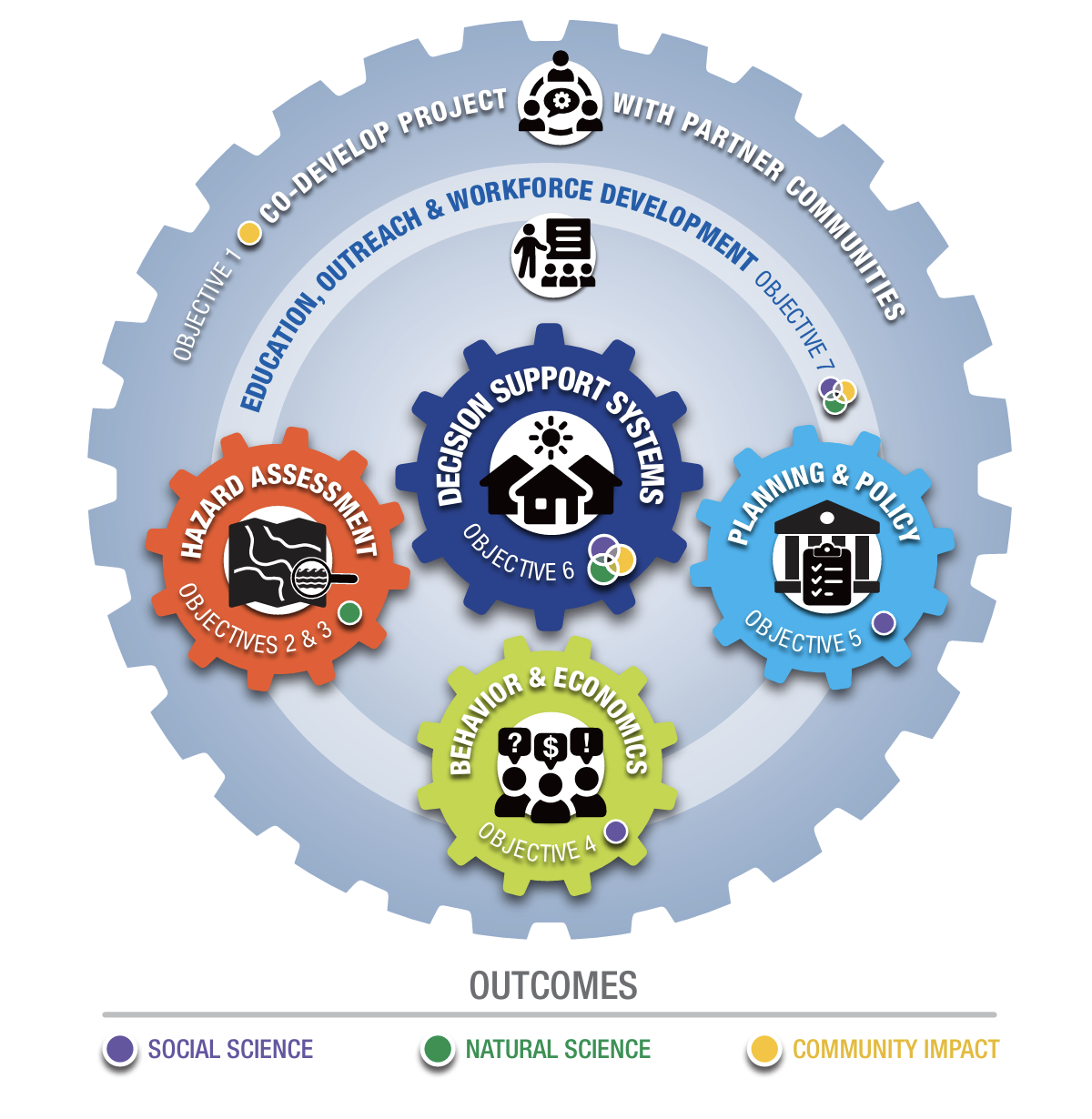
Our Objectives
- Co-develop the project with our partner communities.
- Assess flood vulnerability and flood mitigation strategies.
- Model and map groundwater flooding and salinization vulnerabilities.
- Quantify the economic impacts of flooding and salinization; understand diverse perspectives and support for different adaptation strategies in urban and rural contexts.
- Understand how local decision makers and planners “assess” and “plan” to confront the risks of flooding and other climate-related impacts in their jurisdictions.
- Develop decision-support systems to increase community resilience to flooding & salinization.
- Prepare diverse decision makers to understand the science and implementation of coastal adaptation.
Community Benefits
- Adapt resiliency strategies tailored to specific communities’ needs.
- Deliver accurate information on flooding impacts and software that can be used by communities.
- Predict and inform communities on the availability of fresh groundwater, levels of salinization, and the impacts of groundwater on infrastructure such as basements, septic, and other buried utilities.
- Facilitate conversations on residential resilience strategies with coastal homeowners.
- Allow communities to provide appropriate feedback to elected officials and planners’ ideas for policy intervention.
- Build cross-fertilization of ideas across partner communities.
- Provide web-based resources that help coastal regions better understand current risks and available adaptation strategies, including updated data and models.